
Introducing Oversight Intelligence: A New Standard for Financial Services
- Jul 13
- 5 min read
Today we're publishing "The New Standard for Oversight Intelligence in Financial Services" — a practical handbook and blueprint for regional banks looking to move beyond sampling and achieve full-population oversight across human and AI-led workflows.

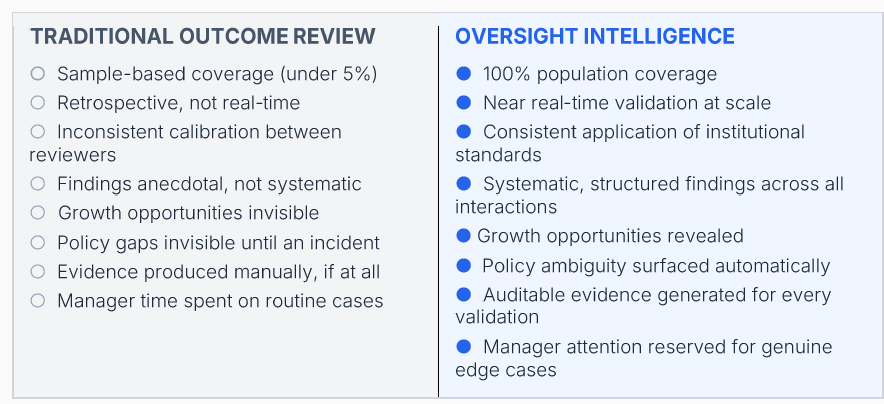
For decades, oversight in financial services has run on the same model: a manager listens to a handful of calls, reviews a sample of decisions, and scores them against a checklist. It's a model built for a world with far less volume, far fewer channels, and no AI-assisted decision-making. It is not built for today.
At most institutions, coverage rates sit in the low single digits — sometimes as low as 0.2%. Managers typically evaluate four or five calls per agent, per month. The overwhelming majority of decisions being made by human agents and AI systems every day go completely unseen.
We call this gap what it is: an oversight problem. And we believe the industry needs a new answer to it.
Why sampling no longer works
The volume of regulated interactions has grown far beyond what any team of reviewers can realistically monitor. Banks have responded the only way sampling allows: reviewing a fraction of what happens and extrapolating from there.
The costs of that gap show up in three places at once:
Regulatory exposure. Examiners increasingly expect institutions to demonstrate — with evidence — that the standards they publish are the standards they actually operate by. A sample can't produce that evidence at scale, and regulatory pressure is growing to increase oversight coverage, especially where sampling has already proven insufficient.
Missed growth. Every interaction carries signal about customer experience, friction points, and revenue opportunity. Reviewing a tiny fraction of interactions means operating almost entirely blind to that signal.
Invisible policy gaps. Institutions that begin reviewing at scale routinely discover that what looked like inconsistent agent performance was actually ambiguous policy — documentation that different people have interpreted differently for years, with no one able to see the pattern because coverage was too thin.
What Oversight Intelligence is
Oversight Intelligence is the application of high-precision instrumentation, at runtime, across the full population of an institution's regulated workflows — with the ability to learn continuously from an institution's own people and policies.
It's a meaningfully different category from "AI-powered QA" tools that simply automate transcription and scoring with generic language models. Oversight Intelligence, as we define it, rests on three interdependent capabilities:
High-precision detection — identifying opportunities, policy violations, and ambiguity with contextual reasoning against an institution's actual procedures, not keyword matching.
Institutional learning — incorporating manager feedback to continuously refine how policies are interpreted, so the system gets more precise over time rather than flagging the same ambiguities indefinitely.
Evidential output — producing structured, auditable evidence for every validation, with citations back to the interaction itself.
Where the evidence clearly supports a conclusion, the system reaches it. Where context is genuinely ambiguous, it routes the case to a human — and that routing is exactly how the system learns. Judgment stays with people. What changes is the scale at which that judgment gets applied and the quality of the evidence it's grounded in.
This isn't a replacement for human judgment, and it isn't limited to AI workflows. It applies everywhere regulated decisions are made at volume — whether by contact center agents, underwriters, fraud investigators, or AI-assisted processes — and it isn't a point solution for a single process. The patterns it reveals across workflows are often more instructive than the findings within any single one.
Where it applies: six workflows
The whitepaper details the six highest-value applications of Oversight Intelligence in banking today, each carrying its own regulatory context but the same underlying vulnerability: partial coverage, inconsistent application, and policy gaps that stay invisible until they produce an incident.
Contact Center Conduct. Agents juggling authentication, disclosure, and complaint-handling requirements across thousands of calls a month. This is where most banks begin — average efficiency gains of 8.5× and estimated financial impact exceeding $10M have been observed in regional bank deployments.
SAR Narrative Review. Suspicious Activity Report quality and completeness varies across investigators, and review resources are limited. Systematic validation has driven a 45% reduction in false positives and $4.5M in annual investigation cost savings.
Dispute and Conduct Risk. The interactions that matter most — agent misconduct, misled customers — are precisely the ones most likely to be missed by a 3% sample. Moving to full coverage has driven an estimated $2.4M in savings from reduced conduct-related rework.
Credit Risk Document Review. Income verification and exception handling inconsistency translates directly into portfolio risk. Institutions have seen a 65% reduction in manual document handling and $4.1M in reduced review costs.
Underwriting Exception Handling. High procedural complexity combined with time pressure creates systematic inconsistency even in well-run teams. Full-population validation has enabled 4× faster exception handling and an estimated $3.7M in annual savings.
KYC/KYB Onboarding. Highly contextual, procedure-dense reviews where over-restriction hurts the customer relationship and under-restriction creates regulatory exposure. Institutions have achieved a 70% reduction in manual second-line review effort and $1.2M in annual review cost savings.
Across all six, the same pattern holds: the gap between what institutions assumed was happening and what was actually happening is larger than sampling ever suggested — and closing it pays off in compliance posture, operational efficiency, and growth intelligence at once.

The blueprint: how any institution can get there
The whitepaper is a practical guide for regional and community banks considering the move to full-population oversight. It lays out:
What a structured proof-of-value pilot produces — population-scale performance data, a policy gap inventory, an internal controls library, and an efficiency baseline — regardless of what an institution decides to do next.
What to expect in the first weeks of a pilot: typically high ambiguity rates early on, as the system encounters edge cases the procedural documentation never anticipated, followed by a rapid decline in required human input as it learns the institution's own interpretive standards.
The three questions worth answering before starting: which workflow carries the most acute risk or opportunity, who the right subject-matter expert is to work alongside the system, and what the institution is prepared to do with the findings.
What the path from pilot to production actually looks like, including integration via SDK or REST API that operates inside an institution's own security perimeter with no disruption to existing infrastructure.
Why now
AI is already embedded in regulated decision-making across financial services, and the volume of interactions requiring oversight is only going up. The institutions that will be best positioned — with regulators, with their boards, and with their customers — are the ones that can say, with evidence, that they know what's happening across 100% of their regulated workflows, not a sample of them.
That's the standard we think the industry is moving toward. This whitepaper is our case for why, and our blueprint for how to get there.
Palqee Prisma is a High-Precision Instrumentation platform for Oversight Intelligence in financial services, trusted by tier-1, regional, and community banks. To discuss a pilot engagement, visit palqee.com/discovery.


Comments